

When a packed tower is underperforming, attention often turns to pumps, blowers, flow rates, or operating temperatures. However, the source of the problem may be inside the tower itself.
Tower packing plays an important role in gas and liquid contact, pressure drop, process efficiency, and overall operating cost. Selecting the wrong packing type or material can restrict flow, reduce capacity, and increase energy use.
Why Pressure Drop Matters
Pressure drop is the reduction in gas pressure as it moves through the packed bed.
Some resistance is expected, but excessive pressure drop forces fans or blowers to work harder. This can increase energy consumption, reduce throughput, and limit tower performance.
The right random packing should provide effective gas-liquid contact while maintaining open flow paths through the tower.
How Packing Affects Performance
Random packing creates the surface area needed for gas and liquid interaction.
A suitable packing design can support:
- Efficient mass transfer
- Even liquid distribution
- Low pressure drop
- Higher operating capacity
- Reduced energy use
- Easier maintenance
Damaged, fouled, or unsuitable packing can have the opposite effect, leading to restricted flow, uneven distribution, reduced efficiency, and unnecessary downtime.
Choosing the Right Material
Packing shape is important, but the material must also match the operating conditions.
Plastic Packing
Plastic random packing is lightweight, cost-effective, and resistant to many corrosive chemicals. It is commonly used in low- to moderate-temperature applications where chemical resistance and low weight are important.
Metal Packing
Metal packing offers greater mechanical strength and is suitable for higher-temperature applications. Its open structure can support efficient gas flow while providing good surface area for mass transfer.
Ceramic Packing
Ceramic packing is often selected for high-temperature and highly corrosive environments. It offers strong chemical resistance and reliable performance in demanding applications.
One Packing Type Does Not Fit Every Process
The lowest-cost option is not always the most economical choice over the life of the tower.
Packing selection should consider:
- Operating temperature
- Chemical compatibility
- Gas and liquid flow rates
- Required mass-transfer performance
- Acceptable pressure drop
- Mechanical strength
- Fouling risk
- Maintenance requirements
Choosing packing that suits the actual process can help reduce replacement frequency, improve efficiency, and support more reliable plant operation.
Improve Performance with Pallchem
Pallchem manufactures and supplies plastic, metal, and ceramic random packing for absorption, stripping, distillation, gas scrubbing, and other mass-transfer applications.
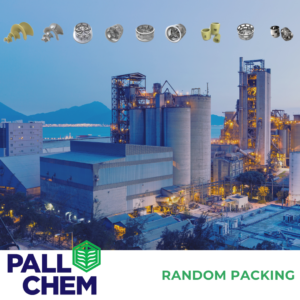
Our range includes Pall Rings, Cascade Rings, Saddles, Raschig Rings, Tri-Packs, and other packing solutions designed for different operating conditions.
Whether you are designing a new packed tower, replacing existing media, or investigating a performance issue, the right packing can make a significant difference.
Contact Pallchem to discuss your operating conditions and find the most suitable random packing solution for your process, www.pallchem.co.za